



Customers are more empowered than ever, and the 2026 State of Product Management report shows only 13.9% of organizations still run a purely project-based GTM, while 58.2% are already partially or fully product-led, with another 27.9% mid-transition. Clear proof that traditional GTM is fading fast.
If you're a product manager, marketer, or business leader looking to stay ahead, embracing a product-led go-to-market strategy could be your golden ticket, and our complete product-led growth guide can help you get started.
But what exactly is product-led go-to-market, and how can it benefit your business? Let's dive into the details, unpack the key principles, and see why it's gaining momentum.
What is product-led go-to-market (GTM)?
A product-led go-to-market (GTM) strategy puts the product at the center of how a company acquires, converts, and retains customers. Rather than relying on outbound sales or top-down campaigns, the product itself becomes the main driver of discovery, adoption, and expansion – often through a freemium plan or free trial.
In product management, a GTM motion is the coordinated way marketing, sales, customer success, and product bring an offer to market, following a practical go-to-market approach that keeps every team aligned. In a product-led motion, that coordination is built around product usage signals rather than demo requests or cold outreach.
A few core terms you'll want to know:
- Product-qualified lead (PQL): a user who has shown buying intent through in-product behavior, such as reaching an activation milestone, inviting teammates, or using a premium feature.
- Time to value (TTV): the amount of time it takes a user to reach their first meaningful outcome in the product.
Product-led GTM vs sales-led growth vs marketing-led GTM
Every GTM motion works differently. The biggest difference is where the buying journey starts and which team carries the most weight early on.
In practice, many companies bridge product-led and sales-led models. A hybrid PLG motion lets users discover value through self-serve onboarding, while sales steps in for larger accounts, product-qualified leads, and expansion opportunities.
When is product-led GTM the right fit?
Product-led GTM works best when users can experience value quickly without heavy setup or sales support. It's especially effective for SaaS products with a short time to value, clear self-serve onboarding, and collaboration or usage patterns that naturally support expansion.
It's less effective when your product requires deep implementation, procurement-heavy buying cycles, or extensive change management before value becomes visible. In those cases, a hybrid PLG and sales-led motion is usually the better fit.
Why shift to this strategy?
The rise of product-led GTM is not just a trend; it's a response to significant changes in buyer behavior. Here's why companies are making the switch:
Customer-centric experience
Today's customers want control over their buying journey. A product-led GTM approach caters to this desire by giving users the freedom to explore the product at their own pace. Instead of being "sold" to, they get to experience the product's value first-hand, making their decision based on their interaction rather than marketing promises.
Lower customer acquisition costs (CAC)
Running a classic, marketing-led stack gets pricey fast. With a product-led GTM approach, your product becomes your best marketing asset. By offering a freemium model or free trial, you allow users to explore your product on their own, reducing reliance on expensive sales teams and marketing campaigns.
Faster time to value
The quicker a potential customer experiences the value of your product, the faster they’ll move through the sales funnel. Our Product-Led Sales Playbook notes companies can reach revenue-ready sales maturity in as little as six months with a PLG motion, compared with the three to five years typical of rep-driven cycles, so instant product access truly shrinks the sales timeline. This cuts down on the time spent in lengthy sales cycles, leading to quicker conversions.
Scalability
Self-serve scales because it pays for itself: 14.3% of SaaS companies already report ROI north of 150% on their self-serve analytics investments, per the 2026 Embedded Analytics Opportunity report. This allows you to reach a larger audience with fewer resources, making it easier to grow and expand without drastically increasing overhead.
How does product-led GTM work?
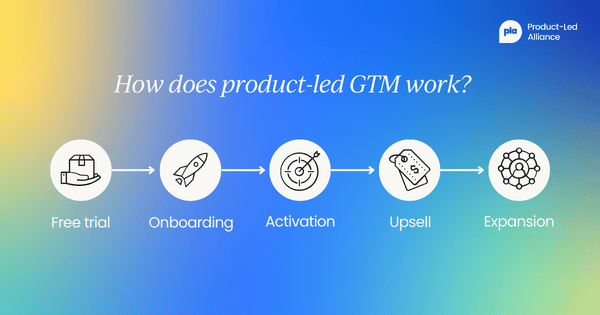
To successfully implement this approach, there are several core components you need to focus on. Let’s take a closer look at these essential elements:
Freemium or free trial offering
At the heart of product-led GTM is the concept of "try before you buy." Offering a freemium version of your product or a time-limited free trial gives users the chance to experience your product's value firsthand. The key here is ensuring the free version is valuable enough to engage users, while premium features should be compelling enough to drive conversions.
Product-led onboarding
A critical aspect is the onboarding experience. You want users to hit the ground running and understand your product's value quickly. Focus on building an intuitive onboarding flow that highlights key features, offers in-app guidance, and nudges users towards those "aha!" moments – where they realize just how beneficial your product can be.
Product-Qualified Leads (PQLs)
In a traditional sales-led approach, marketing-qualified leads (MQLs) are handed off to sales teams. In product-led GTM, the equivalent is product-qualified leads.
These are users who have already engaged with your product in a meaningful way (e.g., by hitting a key milestone within a free trial). When you center sales on product-qualified leads, you’re in good company: 40% of teams now track Activation – the instant a user becomes a PQL – as their number-one metric.
In-product upsells
Upselling happens within the product itself. As users explore your product, you can guide them toward premium features or higher-tier plans with strategically placed prompts or suggestions. The idea is to seamlessly integrate upsell opportunities without interrupting the user experience.
Data-driven decisions
Because users interact directly with your product, you have access to valuable data. You can track user behavior, identify friction points, and use this data to make informed product decisions on product updates, onboarding improvements, and marketing campaigns. The better you understand how users engage with your product, the more effective your strategy will be.
Best practices for implementing a product-led GTM strategy
Ready to shift to this strategy? Follow these best practices to ensure a smooth and successful transition:
Start with a clear value proposition
Before implementing this approach, make sure your product’s value is crystal clear. If users can’t quickly understand what your product does and how it benefits them, they won’t stick around. Invest time in refining your messaging and improve your product positioning strategy so it aligns with your product’s core functionality.
Leverage in-app communication
Your product is your main channel of communication in a product-led GTM strategy. Use in-app notifications, tooltips, and messages (proven strategies to increase app engagement) to engage users at key moments. For example, when a user reaches a milestone or engages with a premium feature, consider prompting them with information on upgrading or exploring more advanced features.
Continuously optimize your product
Your product isn’t static; it’s constantly evolving. Use the data gathered from user interactions to inform future product decisions. Whether it’s adding new features, improving existing ones, or refining the onboarding process, optimization is key to keeping users engaged.
Align sales with product data
In a product-led GTM model, the role of sales teams shifts from traditional cold outreach to a more consultative role. Sales teams should be armed with data on user behavior and a guide to product-led sales, helping them engage PQLs who are most likely to convert. This data-driven approach ensures that sales efforts are focused where they’ll have the most impact.
Common challenges and how to overcome them
While the benefits of product-led GTM are compelling, the transition isn’t without challenges. Here are some common hurdles and how to navigate them:
User churn
Churn risk is climbing: PLA data show the share of teams tracking retention jumped from 12.3% in 2024 to 21.6% in 2025 – a 9.3-point surge that often surfaces first when a free tier falls short on value. To mitigate this, focus on delivering continuous value, improving onboarding, and offering in-app guidance to keep users engaged.
Misalignment between teams
A successful product-led GTM strategy requires tight alignment between product, marketing, and sales teams. All departments need to be on the same page regarding goals, user data, and the customer journey. Regular communication and a unified strategy will help break down silos.
Striking the right balance in your freemium model
One of the biggest challenges is figuring out how much value to give away for free without cannibalizing paid conversions. The key is offering enough in the free version to hook users, but making your premium features so compelling that they’ll want to upgrade.
 Rebecca Madro
Measuring the success of your product-led GTM strategy
How do you know if your strategy is working? Keep an eye on these key metrics to measure success:
- User activation rate: How many users experience the core value of your product?
- Conversion rate: What percentage of users move from the free version or trial to a paid plan?
- Customer acquisition cost: Are you acquiring customers at a lower cost than before?
- Churn rate: How many users are sticking around after their initial experience with your product?
- Product engagement: How often are users interacting with your product? Are they engaging with key features?
Adopting a product-led GTM approach is more than just a trend; it’s a strategic shift that puts your product at the center of your growth efforts. By offering a customer-centric experience, reducing acquisition costs, and accelerating time to value, you’ll be setting your business up for success.
Product-led GTM examples
A few well-known companies show what this motion looks like in practice:
- Slack: grew through team-based adoption, where individual usage expanded into paid workspace adoption.
- Zoom: made it easy for users to experience value immediately, accelerating word-of-mouth growth and conversion.
- Figma: combined strong self-serve adoption with natural collaboration loops that supported expansion into larger teams.
- Atlassian: built a durable product-led engine with transparent pricing, self-serve entry points, and scalable account growth.
- Notion: used flexible self-serve onboarding and team collaboration to turn individual usage into broader organizational adoption.
Want to turn these principles into a PLG motion you can actually execute?
Become Product Led Growth Certified and master the frameworks, metrics, and strategies behind the world's fastest-growing product-led companies: all in a self-paced, expert-built course trusted by product leaders at Atlassian, Google, and Adyen.
You’ll master the foundations of PLG, such as journey mapping, pricing, onboarding, and retention, and apply them immediately with templates and case studies.
FAQs
What is a product-led go-to-market strategy?
A product-led GTM strategy puts your product at the center of how you attract, convert, and retain customers. Instead of relying on traditional sales and marketing tactics, your product is the main driver of customer acquisition, expansion, and retention.
How does a product-led GTM strategy differ from a traditional go-to-market strategy?
In a traditional approach, sales and marketing lead the charge: think heavy campaigns, outbound emails, and sales calls. With product-led GTM, your product is what pulls users in. They get a taste of the value through a freemium model, free trials, or a low-friction onboarding process. Once users experience the product’s benefits, they’re more likely to stick around and upgrade.
Is product-led GTM right for every business?
Not necessarily. Product-led GTM works best for businesses with a product that delivers immediate value, especially for SaaS companies. If your product requires a lot of hand-holding or has a longer sales cycle, product-led GTM might not be the best fit – or you’ll need to tweak it. But if you have a self-serve product that users can easily adopt, product-led GTM can be a game-changer.
Do I still need a sales team with a product-led GTM strategy?
Absolutely! Even though PLG is product-first, a sales team can still play a crucial role, especially when you’re looking to close bigger deals or manage enterprise-level customers. Sales in a product-led GTM world tend to be more consultative, helping users who’ve already interacted with the product and need guidance on scaling their use.


Become a PLA Insider
Thank you for subscribing
Get exclusive insights, frameworks, and strategies from product leaders driving real business impact.
An email has been successfully sent to confirm your subscription.
 Follow us on LinkedIn